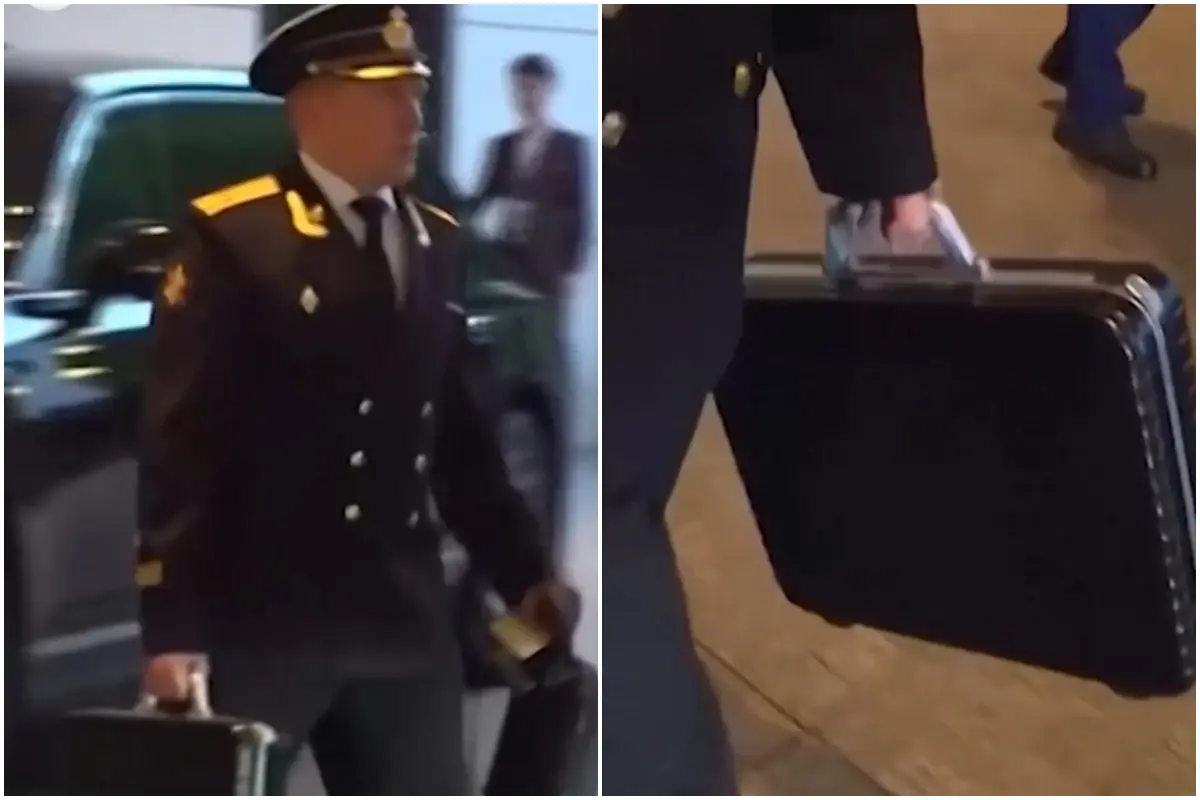
A member of Russia’s delegation carries the Cheget nuclear command briefcase at the APEC summit in Shenzhen, China, on Nov. 18. (Foto: Instagram)
A member of the Russian delegation in China was seen carrying the country’s nuclear briefcase, known as the Cheget, on Wednesday, Nov. 18. A journalist asked the official whether the case was the device capable of remotely activating Russia’s nuclear arsenal. The official replied, “Yes.” Footage of the briefcase was identified as coming from Vesti via Reuters and showed it at the APEC summit in Shenzhen, China.
Russian President Vladimir Putin arrived in China on Tuesday, Nov. 17, accompanied by a group of advisers and allies. He was scheduled to meet Thursday, Nov. 19, with Chinese President Xi Jinping and U.S. President Donald Trump in what the report described as a historic meeting. The Cheget is generally taken wherever Putin travels, and a military officer—typically from the Navy—is assigned to carry it.
The black, armored case weighs about 10 kilograms, or 22 pounds, and is named after Mount Cheget in the Caucasus Mountains of southern Russia. It is part of Russia’s secret Kazbek command-and-control network for its Strategic Nuclear Forces. The system links the head of state with senior military officials to transmit orders and authorization codes through encrypted communications.
Independent institutes estimate Russia has about 5,420 nuclear warheads, the largest stockpile in the world. The United States ranks second, with about 5,042. Together, the two countries hold more than 85% of the world’s nuclear weapons, according to the estimates. The Atomic Heritage Foundation says the Cheget was developed in the early 1980s under Yuri Andropov, then general secretary of the Communist Party of the Soviet Union. It was ready for use when Mikhail Gorbachev became the party’s general secretary in March 1985.
The briefcase was activated once, on Jan. 25, 1995, during Boris Yeltsin’s presidency, after the system detected a rocket launch off Norway’s coast and calculated that Moscow might be its target. Military commanders alerted Yeltsin, the defense minister and the chief of the General Staff, and all three nuclear briefcases were activated. The alert was determined to be a false alarm minutes later, before a nuclear strike was launched.
Military officials then recognized that the object was moving away from Russian airspace and toward the sea. It was a Norwegian research rocket, developed with the United States to study the northern lights. The briefcase is also used in routine technical tests and training exercises involving the president and senior military leaders. It is formally transferred during presidential inaugurations and when a president undergoes a medical procedure requiring anesthesia. Yeltsin received the case during his 1996 heart surgery.