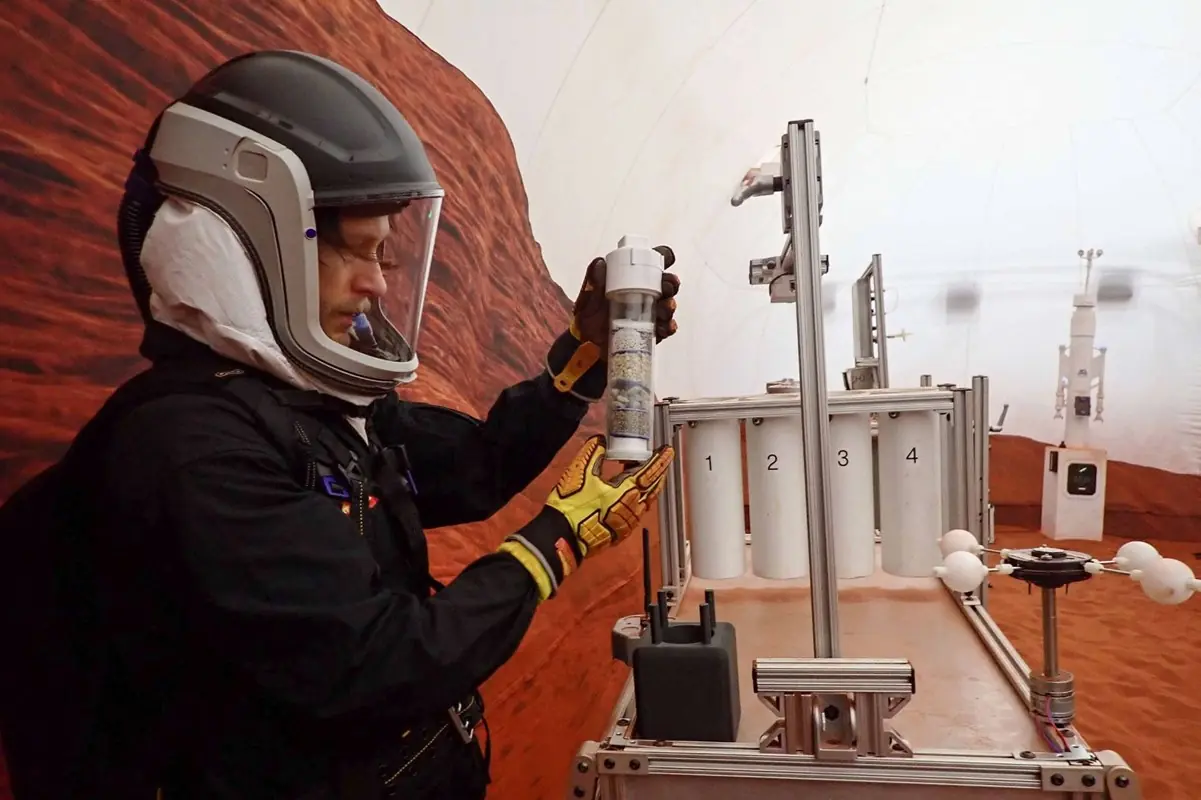
Four volunteers completed a 378-day simulated Mars mission at NASA’s Johnson Space Center in Houston, testing how a crew might handle the demands of a future journey to the Red Planet. (Foto: Instagram)
Four volunteers completed a simulated mission to Mars on Saturday, Oct. 31, after spending 378 days in isolation at NASA’s Johnson Space Center in Houston. The experiment is designed to help researchers understand how a crew might adapt to the physical and psychological demands of a future trip to the Red Planet.
The team included commander Ross Elder, physician Ellen Ellis, science officer Matthew Montgomery and flight engineer James Spicer. They entered the habitat on Oct. 19, 2025, and lived in a roughly 158-square-meter structure built using 3D printing. At the end of the mission, Elder said the crew was honored and proud to have contributed to an effort that could culminate in sending the first humans to Mars.
During the confinement, the volunteers carried out activities intended to mirror work on a long-duration spaceflight. They grew plants, maintained the habitat, exercised, operated robots and conducted simulated walks on the Martian surface. They also worked with limited resources and deliberate communication delays designed to imitate the distance between Earth and Mars. Messages could take about 22 minutes to reach their destination, requiring planning and greater independence from the crew.
The habitat contained compact bedrooms, work areas, a common room and a medical bay. The volunteers were responsible for maintaining the structure and its equipment, and there was no crew rotation during the experiment. The project is part of NASA’s Crew Health and Performance Exploration Analog program, which studies how to keep astronauts healthy, productive and connected during extended journeys beyond Earth.
After leaving the habitat, the four participants are scheduled to undergo two weeks of evaluations and interviews with NASA scientists. The data may help researchers develop strategies for health, performance and crew-living challenges on future missions to the Moon and Mars. This was NASA’s second 378-day simulation; the first took place at Johnson Space Center from 2023 to 2024. The agency aims to send humans to Mars in the 2030s and plans to return astronauts to the Moon before then, for the first time since 1972.