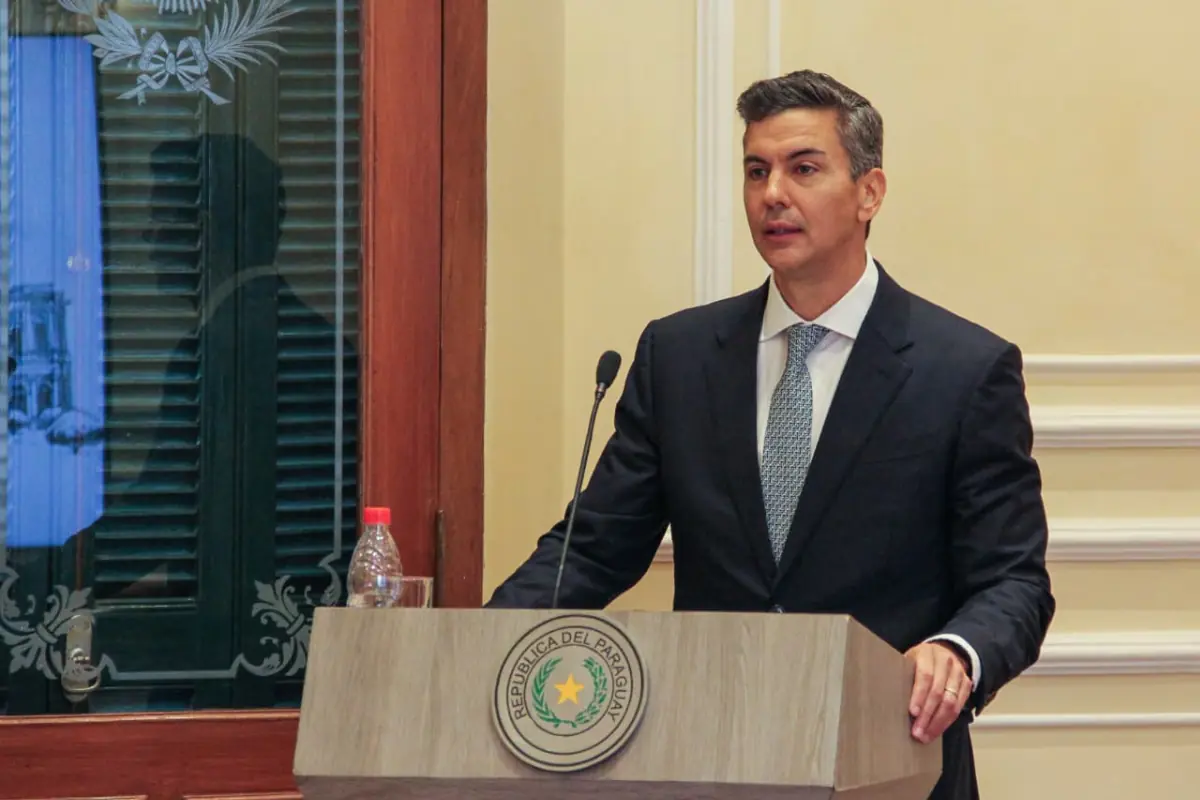
Paraguay’s Senate summoned President Santiago Peña to present his defense in an impeachment trial opened Thursday. (Foto: Instagram)
Paraguay’s Senate has summoned President Santiago Peña to respond to charges in an impeachment trial opened Thursday, Nov. 5. He is due to appear at 10 a.m. Friday, Nov. 6, and may attend in person or send legal representatives to present his defense, Senate President Basilio Núñez said.
The summons came after the trial’s first session ended at 9 p.m. “The lawmakers presenting the charges have already filed their complaint, and the accusations are now being sent to the president so he can prepare his defense,” Núñez said as he left the chamber. The trial began at 7:45 p.m., after the Chamber of Deputies approved the accusation against Peña.
Eight deputies are responsible for presenting the case to senators: Rodrigo Blanco, Raúl Benítez, Rocío Vallejo, Adrián Vaesken, Pedro Gómez, Mauricio Espínola, Luis Fernando Franco and Carlos Núñez Salinas. Peña said in a social media post that he would exercise his right to defend himself Friday and face the proceedings.
Núñez said the Senate would follow its rules, which lay out a process across five extraordinary sessions. After Peña’s defense, senators are expected to review evidence, hear arguments from both sides and hold a roll-call vote. “We are respecting the deadlines set out in the rules because we already face complaints before the Inter-American Court of Human Rights over expedited proceedings,” Núñez said. He said the Senate hoped to finish the trial Friday, if procedural deadlines allowed.
At least 30 of the Senate’s 45 members must vote to remove Peña from office. If senators approve his ouster, Vice President Pedro Alliana would take over under the constitutional line of succession.
The impeachment process followed a political and banking crisis involving Ueno Bank. A joint session of Congress called to consider Peña’s announced resignation failed to reach a quorum after Colorado Party lawmakers left the chamber, preventing the vote from continuing. Peña announced his resignation amid the crisis, but the congressional session to consider it did not proceed.
The Central Bank of Paraguay intervened in Ueno Bank on Tuesday, Nov. 3, after finding that its solvency ratio was below the required minimum of 50%. The intervention suspended the bank’s operations and left nearly 3 million customers unable to access its banking services. Peña, who had previously been a shareholder in a group linked to the bank, faced accusations that he had been complicit in irregularities connected to the financial institution.
Peña apologized to Paraguayans who lost access to their money and said he decided to resign to protect national stability. “I am convinced that no position can be more important than Paraguay’s well-being. I also want to apologize to the people. If I failed at any point, it was never my intention to betray the trust they placed in me,” he said.