

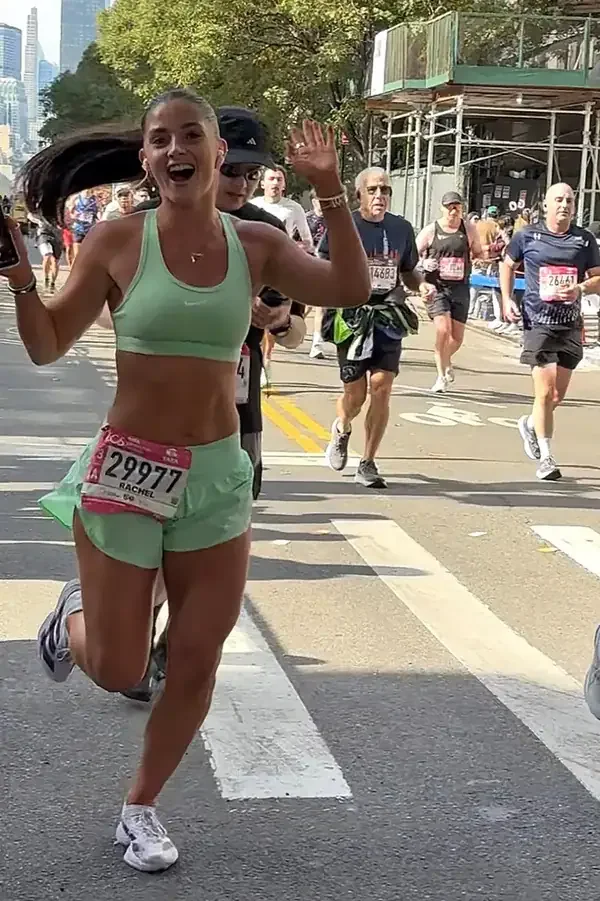

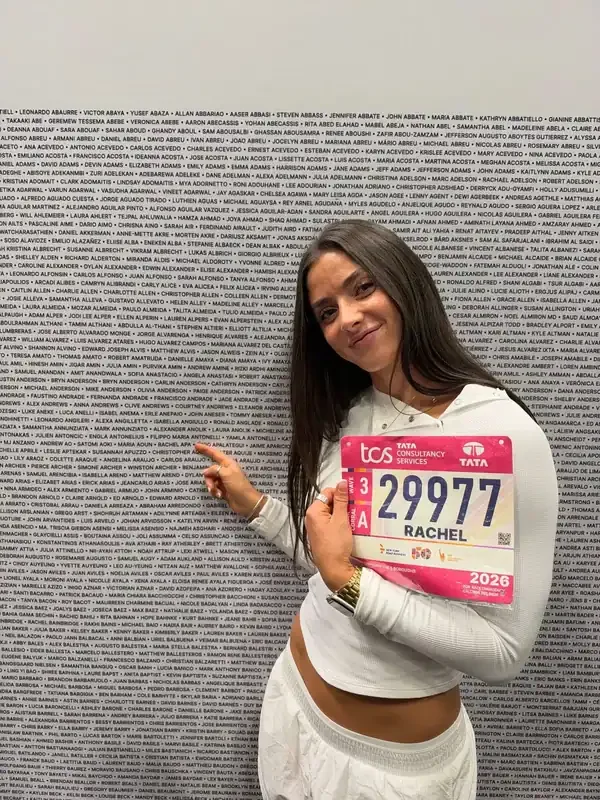

Rachel Apa, a 24-year-old American, died after collapsing during the New York City Marathon on Sunday, Nov. 1. She was taking part in the race for the first time after months of training and planned to raise money for the Parkinson’s Foundation in honor of her grandfather, who died from the disease in 2022. Her father, Steve Apa, said the cause of her death was rhabdomyolysis, a condition involving the breakdown of muscle fibers that can lead to serious complications.
According to The New York Times, Rachel collapsed at about 1:30 p.m. near Central Park in Manhattan. Spectators began providing first aid while medical personnel responded. A defibrillator was used, and Rachel was taken to Mount Sinai Medical Center. Hospital staff tried to resuscitate her for about six hours. Her death was confirmed at 9:40 p.m.
Rachel had played field hockey at Bucknell University and worked as a product manager at an electrical components company. Her family followed her progress during the race. Her mother, Michelle Apa, watched part of the course and recorded a video of Rachel at mile 14. In the footage, Rachel is smiling and greeting the camera.
Steve Apa followed the race from home in Lewisberry, Pennsylvania, using the marathon’s official tracking app. He sent his daughter messages of encouragement as she moved along the course. At mile 18, Rachel replied, “Ouch.” At mile 19, she wrote, “Ouch, ouch.” She did not respond to later messages, although she continued running. When she reached mile 23, her father sent another message, “Home stretch,” but received no reply.
Shortly before Rachel collapsed, she passed spectator Michaela Nicholas, who recognized her by bib No. 29977 and shouted, “Come on, Rachel, you can do it!” Seconds later, Rachel fell near 85th Street.
Nicholas, a social worker at a hospital, went to help and found that Rachel had no pulse. Nicholas’s fiancée called for medical assistance, while other people at the scene, including two doctors, took turns performing cardiopulmonary resuscitation. Nicholas stayed beside Rachel and held her hand during the response. “I told her she wasn’t alone,” she said.
The race medical team arrived, and paramedics transported Rachel to the hospital. Despite the attempts to revive her, she died that evening.
Rhabdomyolysis, the cause identified by Steve Apa, occurs when damaged muscle tissue releases substances from muscle cells into the bloodstream. One of those substances is myoglobin, a protein that can place strain on the kidneys. The condition can range in severity, and potential complications depend on factors such as the amount of muscle damage and how the body responds. A diagnosis is made by medical professionals using a person’s condition and test results; the family’s account identifies the condition in Rachel’s case, but does not provide further details about her medical evaluation.
The condition can develop after intense physical exertion, but it can also have other causes. That general medical information does not establish exactly what happened to Rachel or why the condition developed during the race. Her father’s statement provides the cause of death reported by the family, not a detailed account of the medical circumstances leading up to the collapse.
The symptoms associated with rhabdomyolysis can vary. They may include muscle pain or weakness and, in some cases, dark-colored urine, but symptoms alone do not confirm the condition. Because serious complications are possible, medical assessment is important when it is suspected. Treatment is determined by clinicians and may include fluids and monitoring for complications, depending on the individual situation. These general facts do not indicate which treatments Rachel received beyond the resuscitation efforts described by her family and the report.
A collapse during an endurance event can require immediate attention, regardless of the eventual diagnosis. Cardiopulmonary resuscitation is used when a person is unresponsive and not breathing normally, while a defibrillator can assess heart rhythm and deliver an electric shock if indicated. The account of Rachel’s emergency says that bystanders began first aid, a defibrillator was used, and trained responders and paramedics later took part. It does not specify the results of the defibrillator’s use.
The incident unfolded as Rachel’s parents were following her progress in different ways: Michelle watched part of the course in person, while Steve monitored the app and exchanged messages with his daughter. The video from mile 14 captured her smiling and acknowledging the camera. Later messages from miles 18 and 19 conveyed pain, according to her father, but she continued moving through the course. His message at mile 23 went unanswered.
Nicholas’s account describes the moments around the fall and the efforts by spectators to assist before the medical team arrived. She said she recognized Rachel by her race bib, called out encouragement, and then saw her collapse. After finding that Rachel had no pulse, Nicholas and others tried to help while waiting for professional responders. The two doctors at the scene joined the resuscitation effort, and Nicholas remained beside Rachel.
Rachel had entered the marathon with a fundraising purpose connected to her grandfather’s experience with Parkinson’s disease. The race was her first, and she had prepared for it over a period of months. The information provided by her family and the report recounts her training, the cause she supported, her family’s efforts to follow the race, and the emergency response after she fell.
In speaking about his daughter’s death, Steve described the loss as unexpected. “It’s incomprehensible. Perfect health, perfect physical condition, 24 years old,” he told The New York Times. His comments reflected the family’s shock at her death following a race she had trained to complete and entered in memory of her grandfather.
The chronology reported by the family and the newspaper runs from Rachel’s progress through the course to the collapse near Central Park, the emergency care at the scene, and the attempts to revive her at the hospital. The account identifies rhabdomyolysis as the cause of death, while leaving the precise medical sequence and circumstances of its development unspecified.